
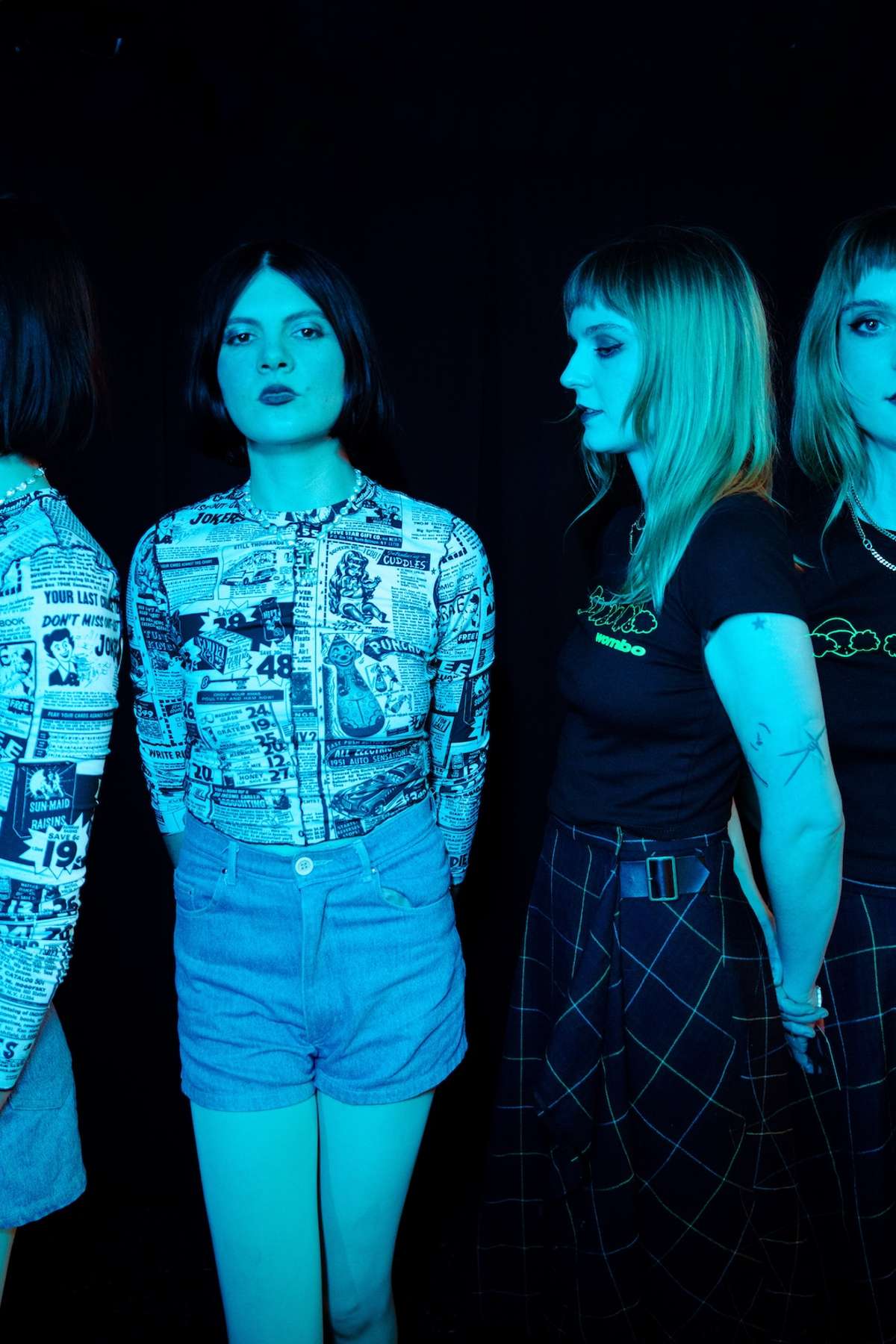
With their second album ‘Excess’, Automatic — Izzy Glaudini (synths, lead vocals), Lola Dompé (drums, vocals) and Halle Saxon-Gaines (bass) — synthesizes a new strain of retrofuturist motorik pop.
It’s often said yesterday’s science fiction reads like today’s grim reality. On their new album ‘Excess,’ Automatic channel both. The LA trio’s second album for Stones Throw rides the imaginary edge where the ‘70s underground met the corporate culture of the ‘80s; or, as the band puts it, “That fleeting moment when what was once cool quickly turned and became mainstream all for the sake of consumerism.”
Using this point in time as a lens through which to view the present, Automatic takes aim at corporate culture and extravagance, weaving deadpan critiques into cold wave hooks. The album’s overarching themes of alienation and escapism emerged as Automatic wrote ‘Excess’ together, fleshing out songs before decamping to the studio for sprint recording sessions with producer Joo Joo Ashworth (Sasami, FROTH). On “New Beginning”, they reject the false hope of leaving behind a scorched planet in search of “a better place”, at a moment when the ultra-rich are eyeing manned space travel: “In the service of desire / We will travel far away”. Imagining the “nihilism and loneliness” of attempting to escape the planet once unchecked consumerism has reached its logical conclusion, the song pictures being “stranded in a space-void with no connection to Earth or humanity.” The band wanted to do away with the tape hiss and raw edges of their 2019 debut ‘Signal’ in favor of more detailed drums and teething low-end synthesizers; brasher sounds for a brasher time. The theme of “I’m On the Edge” – the precarity of the art life – is mirrored in Lola’’s twitchy drumming and Izzy’s erratic synths. “Venus Hour” is “about whatever it is inside you that makes you want to do that thing that isn’t logical, or safe.” The song grapples with the double-edged sword of desire – the fine line between insatiability and addiction. Izzy originally wrote “Venus Hour” as an ode to “psycho-feminine energy”. The final version moves with the verve of Blondie and classic DEVO, an undercurrent of anxiety crackling beneath a très cool veneer. The rest of the tracks on the album were born of extended jam sessions. Halle notes that ‘Excess’ didn’t come as easily as their debut, and that finishing it took resilience and encouragement from all three members, feeding into each other’s ideas and trying new techniques in the studio. One such track, “Teen Beat”, is named for a preset on Halle’s old-school analog drum machine. It bristles with youthful, near-manic energy, with lyrics about the inevitable climate crisis: “Your feet in the water / The fear coming for you.” “To us, the name came to be about Gen Z inheriting the world at the eleventh hour, before they’re even old enough to drink,” says Halle. “Before we landed on ‘Teen Beat,’ we affectionately called it ‘Madness’ — the madness you feel with the state of polarization today.” Automatic imagines a Patrick Bateman type in “Skyscraper” — the kind of sociopath who excels in C-suites and complains about affordable housing going up in his neighborhood. “It’s spending your life making money and then spending it to fill the void created by said job,” says Halle. “Kind of like going to LA to live your dreams,” says Lola. “NRG,” written in a cathartic fritz after listening to Crass and named in honor of disco pioneer Patrick Cowley, grapples with “the unknowingness that comes with testing boundaries and exploring one’s own values while finding your place in the world as an individual,” says Lola. On “NRG”, the trio grapples with their own position — as a band, as a “brand,” as women in the music industry, and how their relationship to their own labor has changed as they chart a course forward into uncharted territory. After all, they’ve got to keep going, and so do you.
But Excess’ final message is one of solidarity, rather than despair. “I can’t stand to hear you talk this way / Like every new beginning ends the same,” opens “Turn Away,” the last song of the album, hearkening back to the visions of failed space excursions. It’s “meant to feel like an arm over your shoulder in a loving gesture.” Instead of succumbing to fatalism, Automatic chooses hope: “There’s a light in the dark / Feel the world open up.” “We want people to feel empowered to do what they can to save the world, to reject any complacency of watching the world burn,” Halle says.
‘Excess’ is a definitive arrival moment for Automatic, who meld the blissful bounce of Tom Tom Club with the techno-futurist inclinations of Kraftwerk, and deliver it all with the listlessness of modern young adulthood. Even the mirrored bodice on the cover reflects the current day: distorted and chaotic with a sleek sheen. As Izzy says, “The record is about what happens to our psyches when we’re conditioned to certain values — the consequences of those values, and the desire to resist them.” Automatic captures the tense energy of our current moment, where questions are plentiful, but answers are scarce.
Accessory is the solo project of Jason Balla, a songwriter and multi-disciplinary artist based in Chicago. Their work centers on the conflict between optimism and melancholy, holding the seemingly-infinite weight of both with equal perspective and grace, pointing to their correspondence through curious and complex melodic experiences that mimic the tension of the natural and digital world. Through his work as Accessory, Balla investigates the impact of their integration in how humanity relates to one another, synthesizing intimate acoustic arrangements and human vocals with electronic mutation.
His debut album Dust is where the celestial meets the molecular. Angels, shooting stars, and lightning converse with blood, serotonin and calcium. The duality of Balla’s self-produced work is meticulously crafted through sonic states of intuition and emotion alongside laborious mechanical manipulation. This altering rejects logic for absurdity while the other focuses on the innate nature of pure feeling. In an era of live-streamed pain and overwhelming apathy as the norm, Balla composed these songs to put his world in order, to get to the human heart of it all, processing the decay for himself and for anyone else feeling the ache of pessimism and hopelessness.
Balla has always been a prolific creator and held a distinctly DIY attitude. At an early age he was running sound in downtown clubs and booking shows across a network of Chicago warehouses and basements where he was first exposed to both experimental music and the possibility of alternative lifestyles. In a testament to his assiduous artistic nature, Dust was recorded on equipment mostly built by himself in his home studio.
While the typical studio environment strives toward sound-proofed isolation, Balla embraces the spontaneity of life happening around him. The chirping of birds in the morning, the crashing of glass on garbage day, even the screaming of passerbys from the alley find their way into the recordings behind a vocal take or overdub. The result is an intimate collage of the elemental and accidental with Balla treating the record as a living organism where mistakes are encouraged and experimentation can flourish. While known for his signature guitar and production work in Dehd, Balla proves his scope as an instrumentalist performing everything heard on album with the exception of the viola lent by Whitney Johnson (Matchesse, Winged Wheel).
Much of the record’s foundation was orchestrated on the piano—a gift from his mother after her passing in 2018. Six years later, after nearly non-stop touring, a break-up with a live-in partner and subsequent couch surfing, Balla found enough stability to move it out of storage. Mornings writing on the piano offered a new perspective on composition and a way to commune with his mother’s memory.
Balla devotes significant attention to how we absorb the people closest to us and the relational dents that impact our lives. This informs much of the lyrics throughout Dust: “Whispering dismissive of a feeling not my own” on ‘Angelfire’; “Catch myself trying to prove you wrong / Still catch myself trying to make you proud” on ‘Blood (Magnetic)’; “I cut my hair to prove I was over you” on ‘This Is Not Your Life (static).’ Balla points to missed opportunities, living with your decisions and our capacity for empathy, consolidating a hopelessness that we’re born with and one that develops as we watch the world burn.
There is a sense of release and transcendence through Balla’s work. It’s a lo-fi heliograph with a Cindy Lee-like tenderness, taking notes from the Copenhagen electro-acoustic scene, SML and the experimental jazz world: an act of discovery that finds its tones amidst guitar feedback and soft balladry. On ‘Calcium,’ persistent percussion accompanies Balla’s relentless vocals that recite images of power and tools of violence, contrasting panicked emotional states with dense instrumental beauty. ‘Safeword’ is a reckoning about losing oneself in pursuit, as Balla searches for meaning within and beyond, wrestling with the very notion of love through a sprawling, sumptuous, dream-like immersion of frantic guitars. ‘This Is Not Your Life (Static)’ is a cathartic vehemence, as the organic and electronic swirl with an unguarded and unfiltered vision.
Accessory acts as a sonic companion, exploring the noise and blur of existence and helping to navigate the suffocating nature of potential evil and the budding essence of tender intimacy. Dust serves as the thesis statement, as Balla contends and struggles with the immorality that often overshadows our boundless ability for connection. These two sides of the record tussle, bearing the weight of acknowledging each other. Balla seeks to rationalize the emotional experience, through metamorphic arrangements that take the familiar into a synthesis world.