
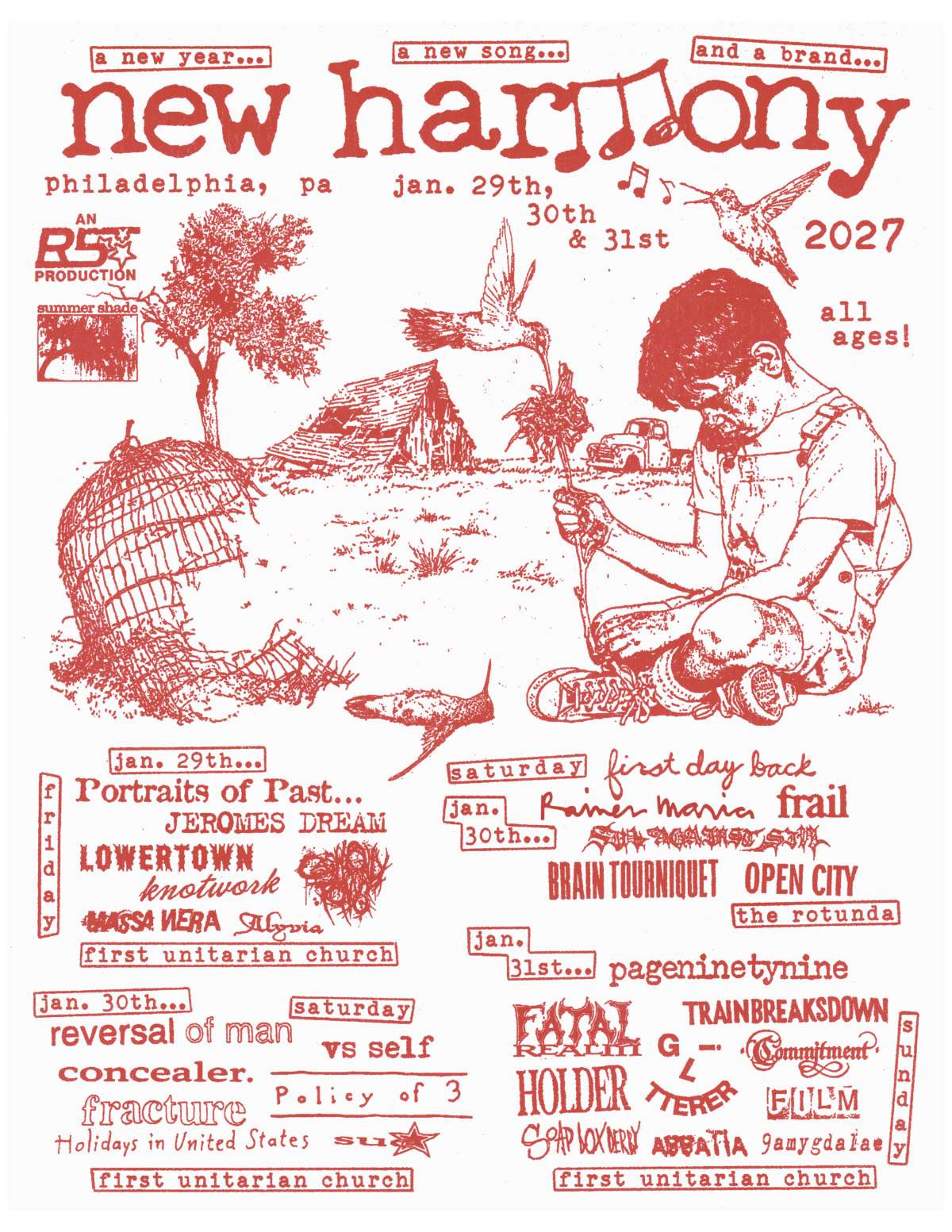
Portraits Of Past prefers to be called a hardcore band, though many other adjectives and sub-genres have been leveled at them over the 30 years since these five childhood friends initially called it quits.
After many years of pent-up demand from listeners old and new, the darkly melodic, explosive, and reluctantly “legendary” five-piece originally from the San Francisco Bay Area is back for Summer 2025 to support a vinyl reissue of their classic 1996 self-titled album. This time around, showgoers can also expect the live debut of tracks from the 2009 Cypress Dust Witch EP.
Jeromes Dream was born in 1997 as a result of personal uncertainty, instability, loss, and rage. Jeff Smith (bass, vocals) Nick Antonopoulos (guitar), and Erik Ratensperger (drums) created an aural violence in their dynamic and unpredictable songs. At that time, bands like Orchid, Reversal of Man and pageninetynine were making similarly polemic music. But JD carved its own path and helped to define the subgenre that would come to be known as emo-violence.
The band set itself apart with an enigmatic and visceral approach to hardcore that was markedly different from the other music of its day, culminating in the release of their last record, Presents, in 2001. That same year, JD hung it up and moved on to pursue other personal projects, and after 17 years, the three friends gravitated back toward the shared belief that JD was a sacred space for them to wholly express themselves.
Fast forward to 2018 when Jeromes Dream announced that they would reunite and write a new record together, despite now living on opposite coasts of the US. The response was overwhelming, with fans from all over the world hailing the reunion. In March 2019 the band entered the studio with producer Jack Shirley (Deafheaven, Gouge Away, Loma Prieta, Joyce Manor) and created a 12-song untitled LP (to be released on their own label, Microspy, founded by Ratensperger) that forges new creative directions, with expanded lyrical content and the compositional maturity that only experience, tragedy, and introspection can usher forth.
Gone are the youthful jaunts of cynicism replete in earlier lyrical content. JD now mine the depths of a pancultural void of empathy and acceptance. JD attempts to reconcile self-interest/awareness with a pervasive inability to affect the global edifices that dominate and influence our every decision.
The band seems to have spliced the threads of time from 2001 to 2019 creating a straight line with no stylistic deviations or missteps. The songs and performances evoke a band that never stopped working and writing together. Moments of clarity and serenity that poked stubbornly through the surface on past albums are now further realized and given sarcous life and the dynamism of Jeromes Dream is more powerful, raw, and sincere than ever before.
Lowertown, the duo of Avsha Weinberg and Olivia Osby, first met in high school math class. They sparked a friendship when Avsha looked over Olivia’s shoulder to see what music she was playing on her laptop, bonding over a shared love of Alex G and The Microphones. They traded influences, and eventually, demos, releasing their first ever single as Lowertown in 2018 before they’d graduated high school. “It was trial by fire,” remembers Olivia, the band’s distinct and off-kilter style initially proving to be an obstacle to fitting in on local bills, but their 2019 debut Friends set things in motion.
From the beginning, their approach to collaboration was shaped by their differing backgrounds. Olivia spent her formative years writing poetry, while Avsha took up classical piano at age 4. The interplay between Olivia’s intuitive approach and Avsha’s measured attention to detail is central to the sound of Lowertown.
Within a short period of the time the duo had signed to a label, and hit the road supporting Wet Leg, quickly followed by a run with Porches, and a national tour with label mates and friends Beabadoobee.
Across three albums, the band’s sound has expanded from their initial indie folk offerings to include flashes of electronica, jagged punk, and beautiful atmospherics. Mood has always been key to the sound of Lowertown, the singular interplay between Olivia & Avsha’s alternatingly raw and melodic vocals playing out over freeform songwriting that Pitchfork described as “fascinating.”
They are now gearing up to go on their first US headline tour. They plan to release their highly anticipated 4th album. The album was entirely written, performed, and produced by the duo in Avsha’s Brooklyn apartment.
Free spirit screamo stuff NYC
Knotwork was an influential mid-1990s melodic and emotional hardcore/post-hardcore band originating out of Delaware County (“Delco”), Pennsylvania, within the greater Philadelphia underground punk and hardcore music scene.
Formed with a heavy musical influence from the first wave of emotional hardcore that preceded them, Knotwork drew deep inspiration from contemporaries and of the era like Turning Point, Encounter, Lifetime, and Still Life.
Formed in 1993 by high school friends Jon Pepe (vocals) and Beau Brendley (guitar), alongside Vince Maskey (bass) and Steve Farrell (drums), Knotwork emerged directly out of a local DIY fanzine of the same name and shared political agenda. Operating with a strict DIY ethos, the band was instrumental in helping support and build upon an already emerging local scene. Knotwork’s members and close peers were an integral part of organizing local benefit shows across non-traditional community spaces, including VFW halls, YWCAs, the West Chester Senior Center, punk houses, and early DIY gigs at Philadelphia’s First Unitarian Church.
Knotwork’s recorded output evolved over their brief tenure: their 1993 demo captured a faster, more aggressive punk attack, while their 1995 EP expanded into a more fully realized, richly instrumented “emotional hardcore” sound. Their concise discography consists of two primary studio sessions:
Self-Titled Demo (1993): A 4-song cassette tracked at Dunjen Studios in Aston, PA.
Self-Titled EP (1995): A 4-song session recorded at the famous Why Me? Studios in Gibbsboro, NJ.
During their active years (1993–1995), Knotwork played only a handful of shows exclusively within the wider Philadelphia area until the band’s dissolution in 1995.
Following Knotwork, its members went on to form and perform in a wide lineage of notable punk, hardcore, and indie acts, including I Hate You, Paint It Black, Kill the Man Who Questions, RAMBO, American Nightmare, Buglite, The University, and Crossed Keys.
Though operating within a brief, localized window, Knotwork’s intersection of emotional intensity and fierce DIY integrity left an indelible footprint on the Philadelphia punk and hardcore scene, cementing their legacy as a vital foundational for generations that followed.
Our present moment sees us grappling with the rise of end-times fascism, the annihilation of collective, shared meaning, and the looming threat of climate catastrophe. It is within this landscape that Massa Nera release their urgent, genre-defying 3rd LP, “The Emptiness of All Things.”
Having been given a commission by the Gabriela Lena Frank Creative Academy of Music to create a work that addresses the climate crisis, Massa Nera embraced experimentation, confrontation, and musical malfeasance in an attempt to capture the hellish inanity that defines our reality. Where once their songs bounced, they now alternately lumber and convulse. Their former impulse towards dance has mutated into a desire for destruction.
Lyrically, Massa Nera has shunned autobiography in favor of something more character-driven, more literary, more speculative. They offer a snapshot of capitalistic delusion and existential paralysis, rooted in the anxieties and fractured psychologies of the here and now. In short, “The Emptiness of All Things” is a lyrical call to arms, delivered not as a rallying cry but as an obituary. It is a mirror held up to the abyss, reflected back at the listener without pity or mawkish sentiment.
Despite this, the band has not abandoned melody. The predominant mood of ugliness is counterbalanced by passages of beauty, longing, and even undisguised gentleness. This gentleness, however, is not in service of an unearned, misplaced optimism. It is offered in the spirit of reflection, allowing listener and band alike to take a breath as they stare into the void.
Four piece from California screaming despair into the vast expanse of hopeless societal decay.