
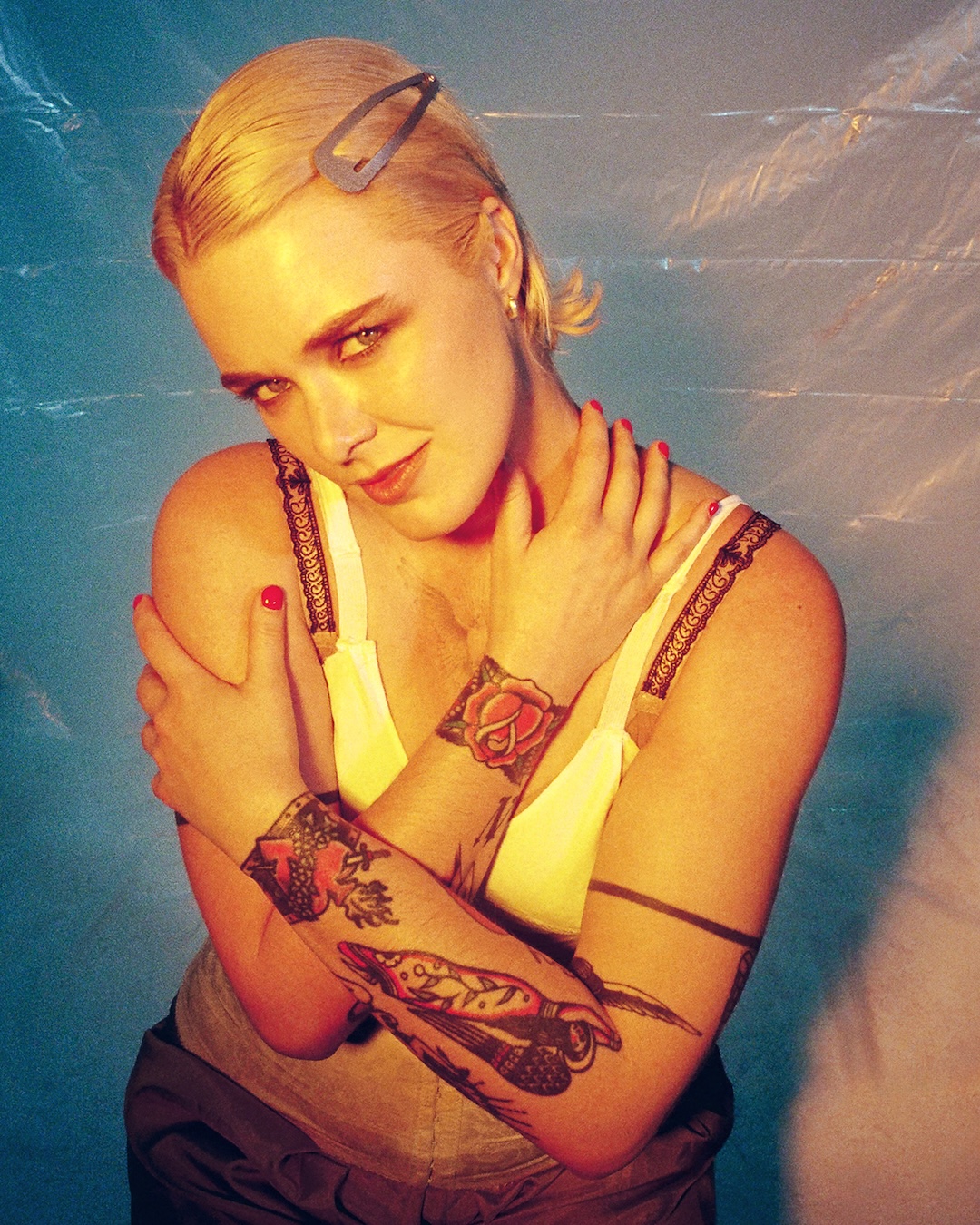
This is a full circle moment for Brennan Wedl. The Minnesota-raised, Nashville-based songwriter has always felt like she was searching for herself, trying on various versions but never really feeling the euphoric ease that comes with finding comfort in one’s own skin. Through experimentation in spirituality and empowerment, devoting time and energy into her craft and learning to lean into a playful, carefree outlook, Wedl is experiencing the delicious life moments with a renewed clarity. On her self-titled album––and debut for ANTI––she shakes off the prying eyes of expectation, leaving behind the anxiety of forming yourself for others and welcoming in the delight of finally being exactly who you are.
Wedl is already a prolific artist, releasing solo music since 2012, and co-founding the queercore outfit Dazey & The Scouts in 2015. The band, she says, taught her about “complete vulnerability and collaboration,” and their surprise viral success on social media fuelled the next stepping stone in Wedl’s career. “It’s shown me the humanity that live music can create,” she says of the unexpected attention on the band. “It’s taught me so much about songwriting as collective care.” After a string of solo singles in 2024, Wedl’s latest LP gathers those foundation-cracking moments that make up a life, and sees her fully immersed in the lessons they create.
There’s a coffee-ringed, neon-hue to Wedl’s songs; blurred faces past foggy windows that add to the anonymity of a new city where an array of outcomes await. After touring and moving around the country for the better part of a decade, Wedl likens home to her favorite snacks, a long phone call with a friend or the hum of a beloved song on an Uber driver’s radio. She grew up in a religious household, and fondly remembers visiting her elderly aunts at their convent. Spirituality still plays a huge part in Wedl’s version of home, but it’s a broader scope than a bearded guy in the clouds; after getting sober, she found herself drawn to meditation, morning pages and the compass of intuition. Now, Wedl looks to her “network in the sky” to notice the patterns in the universe pointing out the next steps.
Wedl enlisted Katie Crutchfield (Waxahatchee) and Brad Cook (Bon Iver, Hurray for the Riff Raff, Mavis Staples) to co-produce and play on the album, with instrumentalists Colin Croom, Lindsey Jordan and Matt McCaughan also sprinkled throughout. Together, they formed a middle ground between punk, grunge and Americana––‘grungetry’ as they affectionately call it––capturing all tracks within a 10 day stay at Cook’s studio in Durham, NC. With Cook’s beloved dog Remy witnessing from afar, Wedl’s songs were recorded live as a band, soaking up the collective energy and shaking off any kind of preciousness about the outcome. It’s a county fair carousel, housing a God-fearing Midwestern teenager; a sharp-tongued DIY punk rocker; a heartbroken, dejected road dog and the newcomer at the Nashville honky-tonk.
“I used to cower at being perceived as anything less than a delight,” Wedl admits, fighting against the old version of herself on ‘High Priestess.’ Forlorn pedal-steel whines alongside the bargaining stage of grief, as a stoned narrator drives by the house of a past forever love but it’s on ‘Pretty Little Fantasy’ that she declares a message of personal power and gender expression, disconnecting from the gaze of others to fully embrace sexuality for herself. A fully-blown, snarling rock song that could be the baby of Hole and Sheryl Crow, Wedl mixes imagery of roses with bleeding teeth; a well-meaning daughter and a crawling creature. “I’m not a girl, I’m a freakazoid” she bellows before the open-armed release of a chorus announcing she’s “not everything you think you can see.” Prodding at societal perception, Wedl says the song is an ode to the murkiness of your twenties, and how fantasising can allow us to be more honest with ourselves.
This fantasy adorns ‘Let’s Be Models’; a sweet, twangy sing-songy ode to playing make believe with your best friends. Bedazzled jeans, jumbotron cameos and topless swimming in a motel pool coalesce into a movie-montage that finds the magic in the mundane. Wedl worked in a lot of indie movie theaters growing up and into adulthood, and ‘Let’s Be Models’ mimics the storied imagination it takes to make it through the banality of reality. ‘Two Dollar Pistol’ is a rallying cry of self-belief, piercing through the noise of distraction to remind us of the scrumptiousness that comes with following your dreams. Simple acoustic strums and lush harmonies by Crutchfield urge us to “step into the light of desire,” and go after what we deserve.
Brennan Wedl is a testament to collaboration, with old selves, the selves yet-to-be and the friends helping you along the way. It’s an anthology of spiritual awakening that sizes up the road ahead, encapsulating the messes and triumphs when leaving a traditional path for something less steady. It feels nostalgic because it’s so universal; like a stranger with a familiar laugh or a paint-stroked memory you can’t quite make out. Growing up is embarrassing and reckless, uncertain and strange, so it makes sense to look for an anchor amidst the chaos. “The archetype of Daddy is something I’ve been searching for all my life, but turns out, the daddy I’ve been looking for has been me all along.” Wedl says. “Be your own daddy.”
Every musician starts off as a fan. Enthusiasm, fixation, denying all self-consciousness in pursuit of your own thrills…these are the values that propel ordinary people deep into fandom. For Grace Bennett and Jade Alcantara, that fervor also propelled their virtual 2010’s Twitter friendship into a band called Sub*T. What started as a cross-country online bond over stan culture—Bennett fighting for the honor of One Direction, Alcantara waving the banner of The 1975—led first to an Instagram follow, then to the mosh pit (where they met IRL several times a year), and eventually to a life-changing decision. In 2019 and with zero prior musical experience, they each bought guitars and taught themselves how to play, and Sub*T was born. While now a fully New York-based band, their sound is better defined by this origin story. Since meeting, Bennett and Alcantara have allowed themselves to be guided not by the pull of their surroundings and the pressure to be at the cutting edge, but by the force that first united them as teenagers on the internet: fandom. And on their debut LP How My Own Voice Sounds, they come into their own, riding the wave of their love for classic alt-rock, grunge, and indie rock and arriving at a place that’s decidedly their own.
How My Own Voice Sounds follows the release of Sub*T’s 2024 EP Spring Skin, which was produced by Momma’s Aron Kobayashi Ritch, and 2021’s So Green, which had Bully’s Alicia Bognanno at the helm. Their first full-length comes on the heels of seven years of touring, writing, and rewriting. “We’ve spent a long time with a lot of these songs,” they explain. “We never really sat down with the intention of writing an album from the ground up, we’ve just been building our catalog for years.” As the duo sharpened their skills, they learned to sit with a song, giving it space to breathe and time to reveal itself. As a result, the 10 tracks on How My Own Voice Sounds feel completely baked, every melodic descent and every turn in the lyrics patiently accounted for.
“The album title itself is more of a statement, but it poses a question we’ve been asking ourselves since we first started our band,” Sub*T explains. “How does my own voice sound? Not in a literal way. We know that much. But how do I want to use it, what do I want to say, how do I want to express all the details of my life so that I can recognize the sound of my own voice and understand myself? This album represents all the ways you can answer that to ultimately hear yourself as you really are.” The duo uses their actual voices in myriad creative ways as they chase these revelations; listen closely to How My Own Voice Sounds and you’ll hear many vocal layers, spoken words, harmonies, laughing, whistling and whispers. “Those are really intentional choices that play off the album title, trying to push through all that noise,” they say.
Such vocal play is woven into the gorgeous textures of “Mirror Image,” where Bennett follows Alcantara’s lead with a harmony that’s semi-whispered, the low but present buzz of a phone in someone else’s pocket: “Like a phantom limb, never too direct.” “This song is about looking deep within yourself and facing the hard parts you aren’t proud of,” the duo says. “We did something fun on the bridge–it’s actually a reversal of our voices. That’s one of our favorite moments on the album. It really sounds like a gained emotional freedom.” The grungy and pummeling “Overcomplicate” represents two sides of yourself talking to each other: “There’s a second whispered vocal layer in the bridge, and we saw that as being the other voice in someone’s head–the negative, cynical voice that you have to fight against.”
While there’s obvious depth and a strong undercurrent of melancholy in Sub*T’s music—on just this release, they confront shadows like vibrato and fear, loss and growth, nostalgia and grief—what simmers beneath is Bennett and Alcantara’s willingness to crack a joke in the middle of an otherwise somber moment. This shared humor is found in the bite of “Imaginal Cells,” a song that laughs at inflated male egos, and the storytelling of “Wide Load,” which actually started as a strangely poetic email their friend received from her Grandma Dottie years ago: “I got my oil changed and that’s as social as I get.” (Wide Load was the name of Grandma Dottie’s cat). “You have to laugh at hard situations sometimes,” Bennett says. “Sometimes when you’re singing about sad stuff, making a sad song about it makes it worse.” Far from a sign of immaturity, being down to clown is indicative of their maturity as songwriters; it’s a product of the confidence they worked so hard to cultivate. “Three years ago, if we would have brought those lyrics to each other, we would almost be too afraid that they’re too on the nose or too honest. A lot of the record is, you know, you’re a bit insecure, but on the other side of the coin, there’s this confidence.”
Bennett and Alcantara each write on their own, but they often feel their songs come to life when voiced by the other. “I just feel like she can transform it in a way I couldn’t by myself,” Alcantara says of Bennett. “And when I hear it through her voice, I hear it in a different way. It’s almost like I gain confidence. Like, the lyrics can be great, but if it doesn’t make you feel the magic, it’s not ready.” It’s an interesting turn, how one writer’s words achieve authenticity when sung by another’s voice. It might be Bennett singing in “Standing Room,” but it was Alcantara who wrote the majority of that song about the experience of being at her mom’s funeral. Ultimately, the emotion Bennett gave it by applying her own experiences as well made Alcantara connect to the song even more. They coined one of the LP tracks “Sister Species” as a way of describing someone whom you can see a lot of yourself in, or seeing a version of yourself you can become–an apt reflection of their own bond.
This closeness, the sense of feminine camaraderie between Alcantara and Bennett, is central to Sub*T’s appeal. Listening to How My Own Voice Sounds, you get the sense of mutual affection and support that undergirds not only the songs, but the pair’s shared discipline as songwriters, patience as artists, and chemistry as friends. Credit it to shared traumas or their years spent on stan Twitter vying for 1D and The 1975. While their tastes have evolved—they credit Juliana Hatfield and Liz Phair as inspiring both their writing and their attitude—their ability to stand alongside one another has only strengthened.
So this is how Sub*T learned to define the sound of their own voices. They gave it time. They sat with it. They allowed artistic truth to lead the way. And ultimately, they played and played and played. Because when you love music, when you’re really a fan, that’s just what you do.