
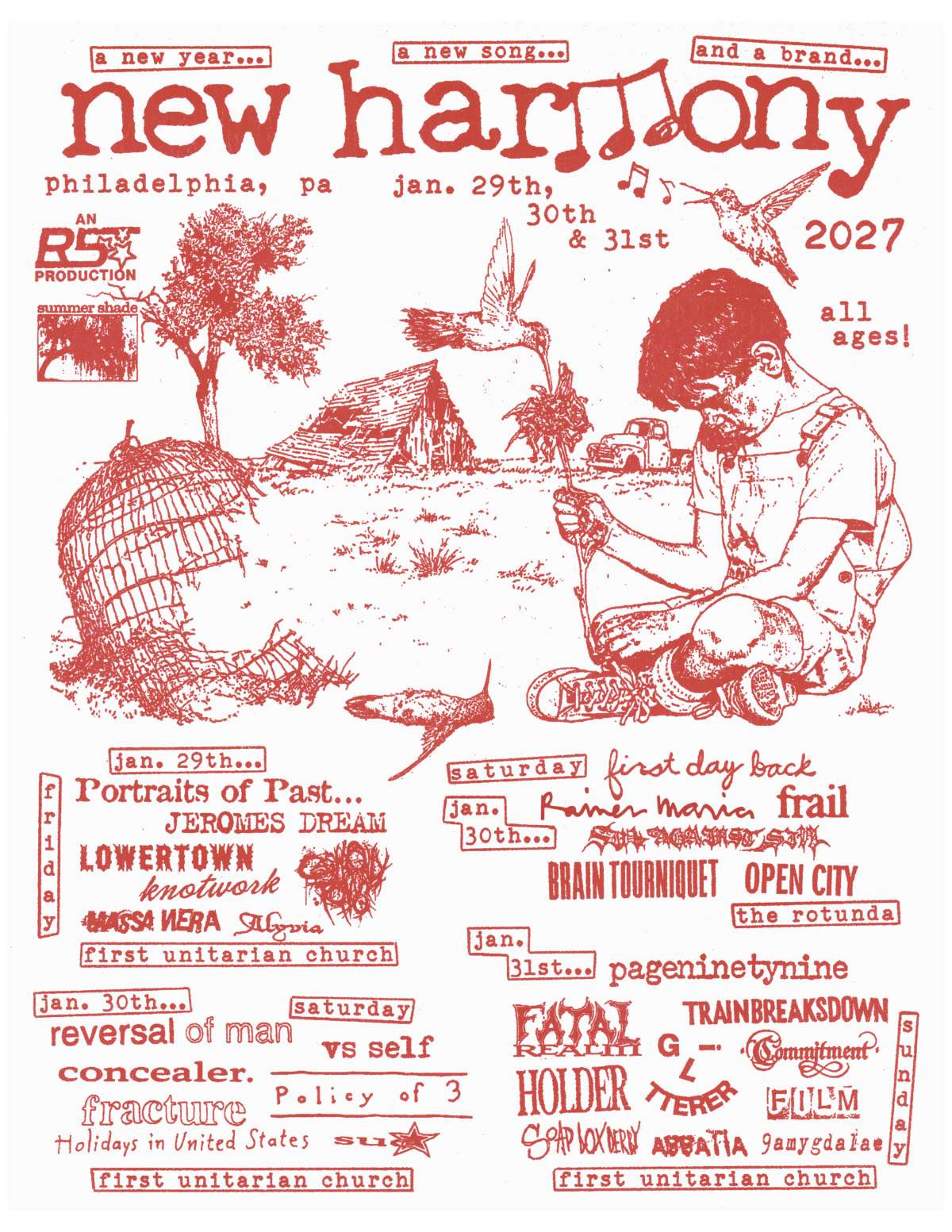
Thundering out of Santa Cruz’s thriving and resurgent music scene, First Day Back have spent their final years in college solidifying their place in the emo revival revival. Heralded as the rightful torchbearers of second wave emo, First Day Back recalls the vocal exasperation of Cap’n Jazz, the twinkle of American Football, and the youthful exuberance of Braid, all while reinventing the sound with the organic additions of violin and harmonica.
Their debut and sole album Forward, self-released in June 2025, was recorded utilizing the acoustics of their Empire Grade house living room, and a muted blue that graces the cover matches the outer panelling of this sentimental domicile key to to the band’s foundations and process. “Forward enchants on first listen, Pitchfork wrote in their 8.1 review “First Day Back play with a transparency usually reserved for private moments: screaming into a pillow in your bedroom, or putting your hoodie up to stress-cry on the bus.”
The quintet’s DIY perspective continues in their live show, which began in houses and anarchist bookstores before blossoming with sold out tours opening for Algernon Cadwallader, Everyone Asked About You, and Jejune, where thousands of kids screamed along to every word, wax, and woo.
If you happened upon the front page of the New York Times arts section on April 13th, 2006, you might likely have been taken by one of two reactions. Perhaps “Who?” Or maybe for the long devoted adherents, “Finally!” There they were, a trio who came up in the idealistic confines of Madison, WI, and the fertile incubator that was the Midwest’s ‘90s indie rock scene, now perched atop a Brooklyn warehouse with the sunset-drenched Manhattan skyline behind them. Momentary conquerors at what would turn out to be the tail end of a decade of trailblazing creativity, Rainer Maria had reached a mountaintop of sorts, and yet by the end of the year they’d be bidding farewell to sold out crowds at the Bowery Ballroom and Williamsburg Brooklyn’s now almost mythical DIY haunt, Northsix.
A decade earlier, during the summer of 1995, Kaia Fischer, William Kuehn, and Caithlin De Marrais, collectively Rainer Maria, were getting their start in a college town not necessarily known as a nexus for any scene. That isolation may have proven fruitful as they crafted their own unique sound, spinning raw and tumultuous emotion into introspective rock songs, with literary and philosophical interests and influences that endeared them to many also searching through the underground for their place in the world. A self-titled EP released in 1996 would be followed by signing to the then nascent Polyvinyl Records and the release of their first full-length albums, Past Worn Searching and Look Now, Look Again.
Those rst releases, paired with an ambitious amount of time spent in DIY spaces, basement shows, and rock clubs throughout the US, fostered a dedicated following for the trio while connecting them to other scenes and musicians throughout the country. Rainer Maria, likely without realizing it at the time, were on their way to cementing themselves as an early cornerstone for Polyvinyl, and as ambassadors of the midwest indie rock scene now so revered by later day musicians and fans. In 1999 they moved to New York City, in part to be closer to family and loved ones, but with the added effect of further unconsciously spreading that gospel.
Throughout the rst half of the aughts, Rainer Maria would release three more full-length albums. Evolving their sound as they tightened their craft, the band continued to hit the road with opening acts ranging from Ted Leo and Rilo Kiley to the Yeah Yeah Yeahs, whom Rainer Maria took out on tour for the then young band’s rst string of East Coast dates outside of New York. By 2006, however, Rainer Maria were feeling the strain of having spent life since their late teens as part of the same band. Collectively, they felt a desire to explore other avenues of living, and so, after a few rapturous farewell shows attended by fans from around the world, Rainer Maria hung up their hats.
De Marrais moved out of the City, releasing two well-regarded solo records of intricate, meticulously crafted pop. Kuehn spent time living in Syria and Yemen, studying and playing music with a variety of artists with all sorts of different approaches and ideas. Fischer studied Tibetan language and Tibetan Buddhism at Union Theological Seminary and Columbia University, a journey that brought her into a traditional-style Tibetan apprenticeship and eventually to living in Asia. (During this time, she also came out as a trans person.)
Over the years that followed, offers for shows would come in every so often, but the band were neither emotionally nor geographically prepared to seriously entertain them. Slowly but surely though, they migrated back to the New York City area, and perhaps more importantly, had moved further along on their own personal journeys. So when the latest offer came in a few years ago, the three got together for dinner to catch up and feel out where they all were both personally and musically. While none of them yet felt the allure of the stage, all three were excited with the idea of writing and recording together again, and so in lieu of any new shows, they began the process of writing the songs that would become S/T.
Guided by their shared history as songwriters, and buoyed by their recent adventures and explorations in music and life as individuals, S/T, fits like well worn boots with the spring of new soles. Intuitively written without much post-mortem intellectualization, the album benefits from its origin as an exercise in fun between old friends who didn’t necessarily have the intention of releasing a new record when they started down the path.
The lyrics are full of natural imagery, influenced by the more pastoral setting outside De Marrais’ window—soil and greenery, weather patterns, and other markers of country life. While sonically, S/T retains and even amplifies the core grit and vigor that Rainer Maria has always had as a band. The album also benefits mightily from Kuehn’s hand at production, his first time doing so for a Rainer Maria release. His bandmates implicit trust in him is a guiding force allowing each song to take on its own distinct life without losing a sense of overall cohesion.
In listening, one gets the feeling Rainer Maria were far from the end of their road together as they stared towards the horizon from that rooftop in April 2006, but rather have much further yet to travel.
Being a teenager in the American suburbs of the 1980s and ‘90s often meant that your ideals seemed to outpace your surroundings. By the early 1990s, as a generation came of age that was too young to have seen Black Flag or Minor Threat, straight edge had started to take a militant approach, drawing lines to keep out people who would not blindly follow some of the genre’s shifting ideals. Frail, a straight-edge hardcore band from Willow Grove, Pennsylvania, who were active from spring 1993 to fall 1995, was more focused on communicating ideas and inclusion; they wanted to teach as much as learn, and this duality meant their music was the perfect vehicle to release the tension of that new generation. Their lineup — Mike Parsell and Don Devore on guitars, Brian Berwind on drums, Derek Zglenski on bass, and Eric Hammar on vocals — released 20 songs, a discography spread across a lone demo tape and a handful of small runs of vinyl on various DIY punk labels, all long out of print. Recognizing the impact the band had on their lives, the members of Frail are reuniting in their home state 30 years later to make their own noise once again.
Iron Lung Records has long been fans of the concept album, especially in the punk context. When you have something to say and you take your time to say it, the message sinks in a lot deeper. BRAIN TOURNIQUET has made a crushing and harshly heavy example of this ethos with serious mental health commentary. While powerviolence/hardcore/punk influence of Crossed Out, Man Is The Bastard, and Mind Eraser are at its core, ‘Sinking Deeper Into Madness’, the band’s second album, also incorporates heavy doses of Swans’ bleakness, personal actualizations from outdated self-help tapes, and boundary pushing sonics from 70’s prog.
‘Sinking Deeper Into Madness’ tells the story of an unnamed protagonist whose family urges him to get a lobotomy after experiencing a manic episode. The protagonist ultimately decides to go through with the procedure and experiences extreme bouts of joy, fear, regret, and remorse until his mind ultimately disintegrates into total emptiness.
There is no illusion that the members of Open City don’t have four easily searchable names. It’s, as bassist Andy Nelson says, “impossible to avoid,” that Google will reveal myriad projects and connections to other artists that span the past 30 years of punk and range in origin from New Jersey to California. The mention of it here is a formality that has to be gotten out of the way, for everyone’s benefit and out of respect to the hard work of all other persons involved.
Simply, Open City are a group of experienced rockers who have worked and lived through many eras of punk and hardcore. Their range of influences reflects both those lived experiences and their combined understanding of themselves as artists. Of these influences, vocalist Rachel Rubino has no pretense with the expression of all they connect with in the world of music, and with what they and the rest of Open City worked to achieve with their upcoming Get Better Records released LP, Hands In The Honey Jar.
“The intent for any album this band has created has always been to put together a collection of songs that hit hard, but also touch on a wide range of creative influence. I love Hatebreed as much as I love Beyoncé as much as I love Pissed Jeans as much as I love Bikini Kill.”
On the same topic, guitarist Dan Yemin states, “From a songwriting perspective, we were looking for this record to be rendered from a more expanded palette of influences, while at the same time being more stripped-down sonically. While the band continues to exist in the context of a reverence for the basement epiphanies of the golden age of DIY hardcore punk, we were also making room for UK post-punk influences and some of the more hypnotic and repetitive tactics utilized by Lungfish and Unwound.”
Hands In The Honey Jar features sounds and styles ranging from the emotion of Rites of Spring, the tonal shouting of Huggy Bear, and the rage found on Deathwish Inc. releases at the turn of the millennium. It doesn’t take much work to hear the efforts Yemin refers to on Hands In The Honey Jar. Songs likeFever Dream andNo One Thinks Of You More Than You carry the type of guitar playing you’d hear from emo and post-hardcore bands like Mineral and Hum, while songs likeBobbyandDestined rely on staple post-punk beats from drummer Chris Wilson that can’t be missed.
To produce the record, Open City relied on Arthur Rizk (Power Trip, Show Me The Body, Glitterer) to bring out their vision. Though drums were recorded in a studio space, bass, guitar and vocals were recorded in a wood shop that Rizk uses as a mixing room.
On recording, Yemin also adds “We finished tracking instruments in March of 2020, a week before COVID shutdown. It was a long stretch of time before it seemed safe to start recording vocals. Rachel started coming into the shop to start tracking their parts a full year after the guitars were finished. So the process shifted from ‘fast and spontaneous,’ to ‘drawn out and calculated,’ by necessity because of the public health crisis.”
When it comes to the lyrical approach for Hands In The Honey Jar, Rubino simply kept it real and addressed their life as they knew it.
“For this record, the writing process was a bit difficult to be honest, as we were all so far removed from each other, and from the physical community of our music scene as we knew it. It was definitely a little harder to connect and plug into that part of myself, but I found so much motivation every time we set a date to track. My writing has often come out as a stream of consciousness, usually just before I fall asleep. I might return to my book a few days later, re-read the words I likely forgot I wrote, then piece them together later on fitting them into song structures/patterns. The topics are usually a variety of my own lived experiences, current ideas and events that weigh heavy, little thematic fictional stories that weave together. I think the lyrics always come from a place that’s deeper than I probably understand myself, and that’s the hidden beauty in all of it.”
Rubino goes further to say, “The current landscape in our country that’s trying to erase marginalized groups is a fucking sick joke, it’s impossible to not absorb and feel drained by it. This struggle and heartache definitely finds its way into some tracks. There’s this pressure in America to assimilate or die – literally. The systematic othering and erasure of queer/trans/black/brown bodies is so prevalent here it’s hard not to feel lost in a pit of despair. Watching others lose their compassion for humanity, dignity, and equality is a literal nightmare. I only hope folks can find music or art or literally anything that helps them navigate a way to battle these pervasive harmful ideologies. I did as a young teenager and I’m forever grateful for this.”