
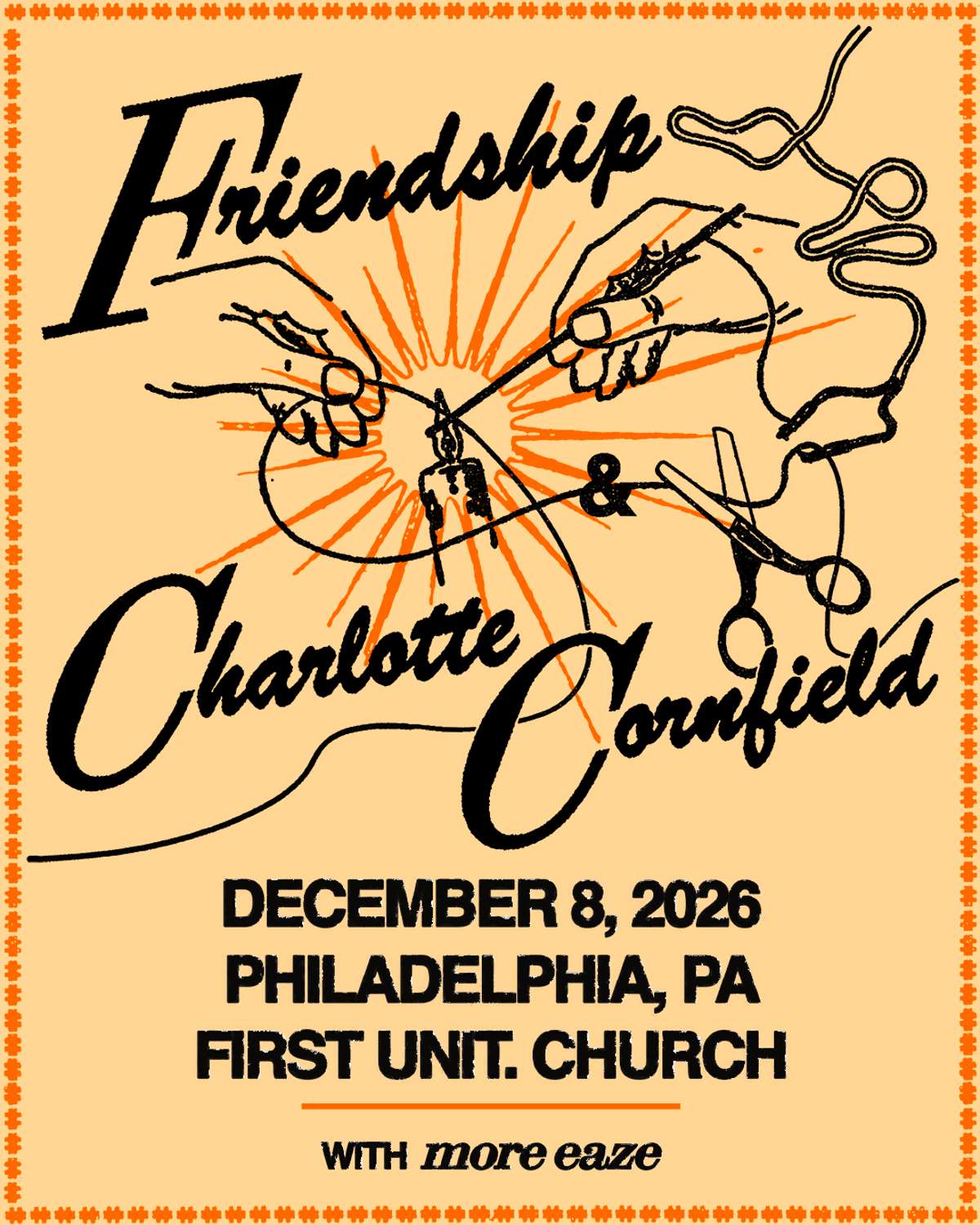
Music for sleeping and waking, walking and driving, hunting and fishing, for loitering outside a roadhouse on the haunted tundra. Okay in elevators, not great for dinner. On Caveman Wakes Up Friendship’s new album and second for Merge Records, the band’s historically capacious definition of country music grows wider still. Shambolic guitars are offset by flute pads, bleary poetry is set against a Motown rhythm section, a song about Jerry Garcia and First Lady Betty Ford fades out with a drum solo, like if Talk Talk came from a dingy Philadelphia basement, and was fronted by James Tate. Songwriter Dan Wriggins’ ragged baritone cuts through eleven murky, swirling country-rock songs with profound lyrical substance and sincerity. Like an alarm clock incorporated into the edge of a dream, Caveman Wakes Up belongs equally to the conscious and subconscious mind, fraught with background, steeped in reference and experimentation, delivered casually and as a dire warning, dedicated, above all, to music’s creative soul.
Over the years, dedication has paid off. Friendship has become a kind of reverse supergroup, wherein the band itself and each individual member is located centrally in an increasingly prominent scene of young folk and country musicians and songwriters. Drummer Michael Cormier O’Leary leads the instrumental collective Hour and, along with bassist Jon Samuels, run Dear Life Records, home to friends and peers who count Friendship as a major influence, including MJ Lenderman, Florry, and Fust. (Samuels also plays lead guitar in MJ Lenderman and the Wind). Guitarist Peter Gill’s band 2nd Grade records prolifically. Wriggins began writing the songs of Caveman Wakes Up on a downtuned classical guitar of Lenderman’s, and finished on a barely-tuned piano in an apartment he shared with Sadurn’s G DeGroot.
In the summer of 2023, Wriggins had just left the Iowa Writers’ Workshop, where his love for poetry and mistrust for the academic poetry world grew in tandem. A relationship fell apart, and Wriggins crashed for several weeks at Lenderman’s and Wednesday’s Karly Hartzman’s home in North Carolina, where he recorded the first demos of “Resident Evil,” “All Over the World,” and “Love Vape.” Wriggins returned to Philadelphia, and the band got to work on new ideas, finally tracking the album in five days with engineer Jeff Ziegler (Mary Lattimore, War on Drugs). Wriggins recorded vocals with Love the Stranger engineer Bradford Kreiger, and organ, violin (Jason Calhoun), and flute (Adelyn Strei) were recorded by Lucas Knapp in a West Philadelphia church.
Lyrically, Caveman Wakes Up covers familiar Friendship ground — the sacred is profaned and the profane sanctified. On “All Over the World,” a landscaper “[feels] the beating heart of God/ laying down a roll of sod.” Characters complain about work and marvel at love. Here, however, we get Wriggins’ first real confrontation with depression, in “Hollow Skulls,” “All Over the World,” and “Resident Evil,” where the soul wages its perpetual war against darkness and stagnation. It often loses. The verses of Hollow Skulls are punctuated by passages of musical emptiness, a single suspended chord and brushes on a snare drum. When Wriggins complains about a roommate, shouting “who’s that shithead in my living room/ playing Resident Evil,” it’s abundantly clear there is no roommate, that the evil resides within.
Caveman Wakes Up showcases Friendship’s particular genius for visionary arrangement, indebted equally across generations to to the folk-rock canon of Neil Young, Joni Mitchell, and Emmylou Harris, to Indie stalwarts like Yo La Tengo and Merge labelmates Lambchop, to contemporaries like Lomelda and ML Buch. Several of the songs employ fade-outs, jokingly referred to in the lyrics of “Love Vape,” and there are other elements lifted from Motown and 70s ballads: locked-in drum patterns, bass intervals, sentimental string arrangements. Each reference is pushed past genre, swirling and repeating, into something new and squarely belonging to the Friendship sound. On “Free Association,” “Artex,” and “Wildwood in January,” the groove is established so that other sounds can come and go seamlessly; mellotron patches, piano flurries and stabs, and clean guitar melodies, teeming textures disguised in unity. As a work of music production, Caveman Wakes Up is Friendship’s most advanced work yet, another testament to the band’s devotion and care.
A droning chord calms nerves. A surreal poem moves us not because it’s familiar, but because it grows, stirs up the stagnant waters. A sizzle in the brain stem. Negative capability. Caveman Wakes Up is dreamy, luscious new growth for a band that has become an increasingly verdant oasis in the crescent of indie country civilization. Sure to excite and mystify, to continue growing, to cause new life.
It’s been less than two years since Highs in the Minuses became Charlotte Cornfield’s break-out—a magnetic mission-statement for the Toronto songwriter described by Rolling Stone as “Canada’s best-kept secret.” Cornfield emerged from pandemic seclusion with new fans, raised expectations, and her first major US tour. She could have kept touring forever; she could have fled to the woods with a four-track. She could have done anything. What she did was jump into an old Subaru, driving seven hours south to the Hudson Valley. The car didn’t have any A/C; she had only recently earned her license; and she had never met the producer she was driving down to meet. But when Cornfield arrived in Hurley, NY, at the red-steepled church that is now Dreamland Recording Studios, she was ready for whatever came next. “There was this letting go of some of the strongheaded-ness that I think I used to have,” she says, “and an embracing of the open-endedness of life.”
Cornfield had come to Hurley to work with producer Josh Kaufman, thrilled by his sublime recordings with Cassandra Jenkins, Anais Mitchell and his own band, Bonny Light Horseman. The album they’d now make together, Could Have Done Anything, is a testament to Cornfield’s uncommon life and all its possibilities, an acknowledgment that the best musicians can turn fleeting moments into timeless songs. Over nine magnetic tracks, the singer-songwriter begins yet another chapter: gazing in the rear-view to understand where she’s been; squinting through the sunset to see what’s ahead. Calmer than I was, she sings in the album’s final moments. Stronger than I was / older than I was / less angry than I was…—and finally—happier than I was / happier than I was / happier than I was…
Whereas Cornfield’s preceding albums were made in familiar settings, with troupes of friends, her latest long-player reaches into the unknown. Kaufman and Cornfield (who went to school for jazz drums) played every instrument themselves, from ringing guitars to cozy piano, Hammond B3, pedal steel and synthesizers. Together with engineer D. James Goodwin (Kevin Morby, Whitney) and assistant engineer Gillian Pelkonen, the pair worked swiftly, impulsively, trying to shrink the gap between having an idea and putting it on tape. The resulting sound is at once elaborate and unrehearsed; there’s a sense that it’s coming together—and coming alive—at the very moment it’s being made.
“The hours flew by,” Cornfield says. “We lived inside of the songs there, for a few days.” You can hear it on a tune like “Cut and Dry,” where a radiant, easygoing groove forms the landscape of a song about seeing people as a whole, together with their mistakes. There’s a similar throughline to “In From The Rain,” where rambling 70s licks and Cornfield’s tambourine flutter trace the evolution of a friendship, from intimacy to disappointment to acceptance. On the latter, listen at the end of the first minute, after Cornfield sings a lyric about rainstorms and visitors: Suddenly you were there, goes the line—as a real-life thunderclap unfurls, like an angel’s drumroll. “All the mics picked it up,” she recalls. “So we left it in.”
“Gentle Like the Drugs” draws on imagery from a spring tour in the American west. “I was experiencing joy on the road in a way I really hadn’t before,” Cornfield says, and you can hear it in the patient pleasure of these chords, or the way she narrates her first impressions of Arizona: I watch the colours get real / the pink and the teal / I see a dust devil / I see an elevator. Like riding across the desert with your friends; like smoking a joint at the end of a long day; but the song’s alternating verses orient themselves towards another sensation, too: that feeling of being home, and happy, when your lover’s not around. Not because they’re gone, but because you know they will return.
Intimacy and absence go hand-in-hand on Could Have Done Anything: the theme repeats on the unfussy love-song “You and Me,” with its tale of tour and homecoming. You’re sunkissed in your Subaru / Picking me up at Terminal 3, she sings—and, later, two bikes on a pavement path / ice cream cones and epitaphs. Some love is as simple as this: liberating, easy, like piano and guitar in two-step. “I’ve been trying to write a song like this for a long time,” Cornfield says. “A catchy love-song, with cars. Where it feels like the narrator could go anywhere and do anything.
That was the spirit of this record: connection, possibility, acceptance. “Don’t be afraid to take a left,” Kaufman would say, encouraging Cornfield to drop preconceptions, invent new rules. Even with the small things, like wandering around the tracking room with a pair of claves in your hands, or adding random, surround-sound echoes to “The Magnetic Fields”—a song about a potent and formative live concert experience. Throughout, Cornfield tried to channel the energy of her favorite classic records, from Tapestry to Blood On The Tracks to Car Wheels On A Gravel Road—albums where the listener is simply carried by the songs and the playing.
After six days, Cornfield went back to Canada, with a new album to mix and master. Another day-long drive; another homecoming; and one more thing, too, which would arise a little over nine months later: the singer’s first baby’s due April 2023. Anything can happen.
more eaze is the project of brooklyn-based sound artist and multi-instrumentalist Mari Maurice. Ranging from ambient pop to folk and musique concrete, her numerous solo and collaborative releases weave mundane, everyday sounds, acoustic orchestration and instrumentation, and electronics into adventurous textural compositions. Her music explores themes of intimacy, yearning, Americana, and the transformation of abstract feeling into intense living through compositions that move seamlessly between the banal and the ethereal. She has recently released work with Thrill Jockey, 15 Love, Longform Editions, Leaving Records, Ecstatic, and Orange Milk. Her work as a string arranger, pedal steel player, and producer has recently been featured on recordings by Martha Skye Murphy, Water Damage, Lomelda, Fashion Club, Claire Rousay, Space Afrika and Rainy Miller, and Nick Zanca amongst others. She regularly performs in the duos Pink Must (w/ Lynn Avery) and whait (w/ Wendy Eisenberg).