“Leenalchi has changed the way I think about music, dancing and Korea. I have never heard anything quite like this.”
— Brian Eno
“I’m grateful to hear this Korean classical form used so playfully, in danceable guitar/synth rock, with serious hooks. Hihi! Haha! Hihi!”
— Merrill Garbus (of Tune-Yards)
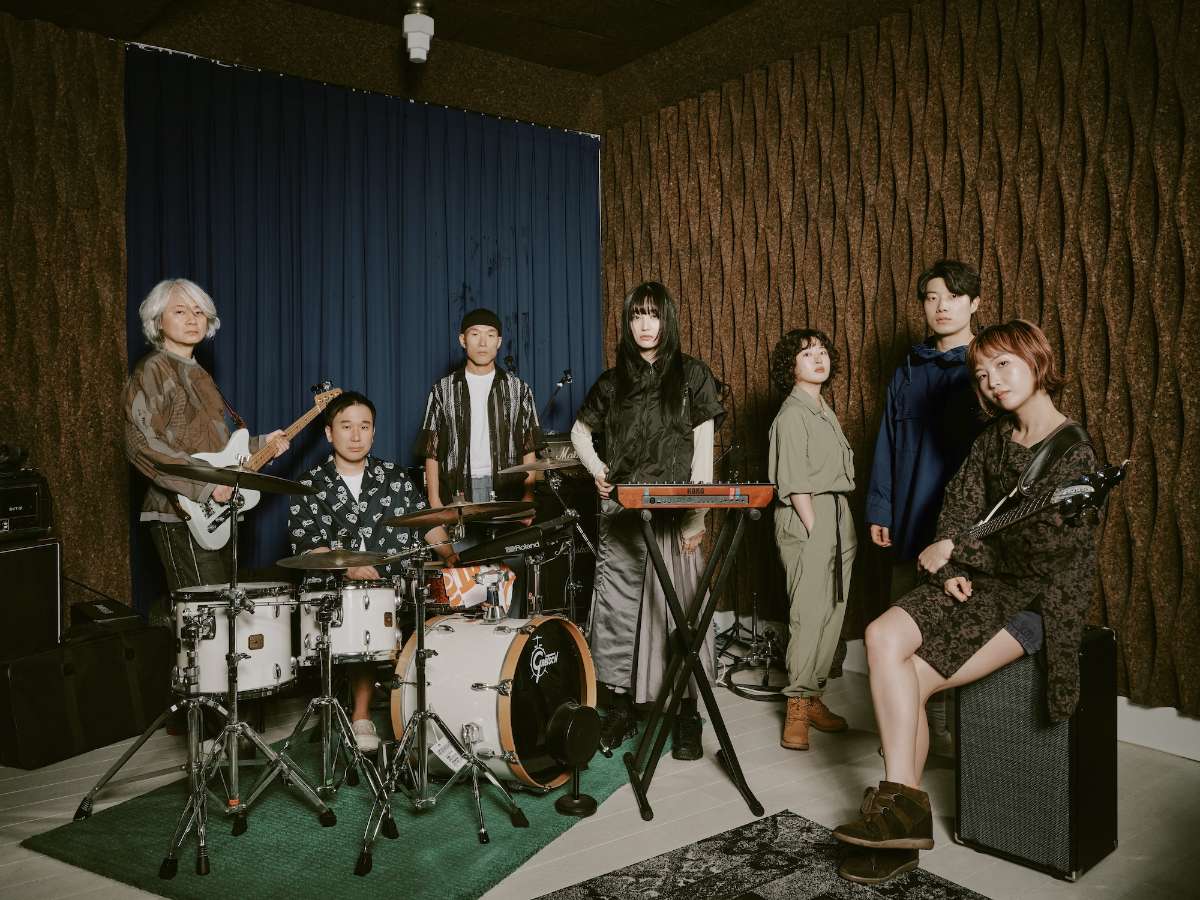
Leenalchi (EEE-nal-chi) — the seven-piece Seoul-based band led by bassist Jang Young Gyu — announce their Luaka Bop debut, a new EP entitled Here Comes That Crow, out June 12th, and a North American tour. In conjunction with today’s announcements, they present the video for lead single and title track, “Here Comes That Crow.” The music of Leenalchi is taken from pansori, a traditional Korean style of musical storytelling often compared to opera. Rooted in shamanism and developed during the Joseon Dynasty (17th century), these songs tell epic tales of love, virtue, sorrow, and As if reverberating in our ears from a spiritual plane, the sounds emitting from Leenalchi’s singers are transcendent. Their line-up, as singular as their sound, features two bassists, drums, keys, no guitar, and four singers.
The psychedelic riffs found in Leenalchi’s songs are courtesy of Jang, the band’s enigmatic leader, who looms large in the country’s small but dedicated indie music scene. An NPR Tiny Desk concert of one of his former bands, SsingSsing, racked up 9.9 million views on YouTube and was praised by Tiny Desk founder Bob Boilen as “one of my most memorable Tiny Desk Concerts of all time.” He’s also a prestigious film composer, scoring soundtracks for some of Korea’s most celebrated movies like Train to Busan, The Wailing, and The Good, the Bad, the Weird.
Jang’s work with pansori began in 2007, after composing for choreographer Ahn Eun-me’s piece, Bari. With musicians from that project, Jang went on to form groups such as BIBING, SsingSsing, and eventually Leenalchi.
On “Here Comes That Crow,” as on most Leenalchi songs, Jang wordlessly directs his vision of cross-cultural funk with a collaborative spirit. First comes the rhythm section, developed with drummer Oh Hyung Suk, which sets the foundation for a song, then, singers Park Soo Bum, Ahn Yi Ho, Ra Seo Jin, and Choi Su In draw from the repertoire of pansori songs to discover the most distinctive and fitting sounds.
Adapted from a pansori tale about the Chinese warlord Cao Cao’s most decisive battle, “Here Comes That Crow” is an allegory about life’s precariousness. Ahn, together with his fellow Leenalchi members, wrote a poem to help listeners interpret the song’s meaning:
도용도용은 작은 배가 물위를 떠가는 모양을 그린 말이다. 조조도 조자룡도 쫓기는 자도 쫓는 자도 멈출수는 없다.
판자때기 아래가 저승인데 어느 누가 멈춰 설 수 있겠는가!
Doyung doyung goes the small boat seen floating down the river.
Whether the chased or the chaser, no one can stop—just beneath the boards lies the underworld!
As part of their training, pansori singers are required to spend time singing next to a waterfall, tasked to carefully observe and mimic the sonic nuances of water. The Korean language is full of onomatopoeias. The repetition in these words create their own rhythmic unit, each word functioning like a tiny song: Kwal-kwal (콸콸) is the sound of a running stream; gaegul-gaegul (개굴개굴) goes the frog; and mimetic words (a slippery floor is mikkeul-maekkeul (미끌매끌); sol-sol (솔솔) is a kind of gentle and subtle slowness).
The band counts many fellow artists as fans, including Brian Eno, Robyn, Japanese Breakfast, Sylvan Esso and Merrill Garbus (of Tune-Yards), who studied pansori while part of the group Roomful of Teeth.
This summer, Leenalchi will embark on their first-ever North American tour, making stops in Canada and the West coast, including Stern Grove Festival in San Francisco where they’ll support Japanese Breakfast, and a free show at The Getty in Los Angeles presented by KCRW.