
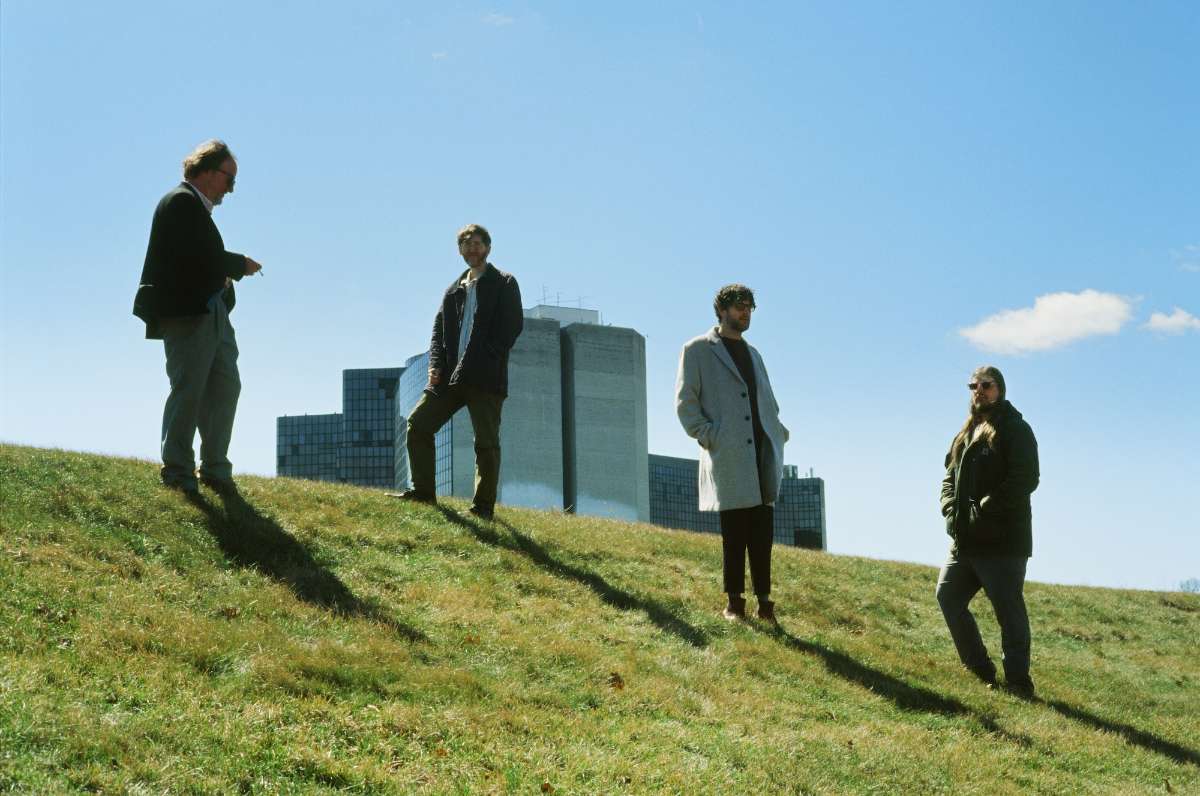
Since their 2012 debut No Passion All Technique, the Detroit post-punk band Protomartyr have mastered the art of evoking place: the grinding Midwest humility of their hometown, as well as the x-rayed elucidation of America that comes with their vantage. Protomartyr—vocalist Joe Casey, guitarist Greg Ahee, drummer Alex Leonard, and bassist Scott Davidson—have become synonymous with caustic, impressionistic assemblages of politics and poetry, the literal and oblique.
The group’s sixth album, recorded at Sonic Ranch in Tornillo, Texas, is called Formal Growth In The Desert. And though frontman Joe Casey did have a humbling experience staring at awe-inspiring Sonoran rock formations and reckoning with his own smallness in the scheme of things – as recounted in the single “Elimination Dances” – the title is not necessarily a nod to the sandy expanses of the southwest. Detroit, too, is like a desert. “The desert is more of a metaphor or symbol,” Casey says, “of emotional deserts, or a place or time that seems to lack life.” The desert brings an existential awareness that is ultimately internal.
The “growth” came from a period of colossal transition for Casey, including the death of his mother. Now 45, Casey had lived in the family home in northwest Detroit all his life until 2021, when a surge of break-ins signaled that it was time to move out. As with all touring artists, the pandemic years also brought on other inner quandaries about the purpose and feasibility of a musician’s life.
But life does go on, and Casey describes the great theme of Formal Growth In The Desert as an embrace and acknowledgment of that fact: a 12-song testament to “getting on with life,” even when it feels impossibly hard. “I was trying to find a way forward after some pretty heavy things, without lyrically resorting to, Oh my god, my life sucks,” Casey says. “I was trying to see what was beyond the trouble.” The titles of the two opening songs—the moody “Make Way” followed by the charging ennui of “For Tomorrow”—complete that thought.
The band’s music—more spacious and dynamic than ever—pulled him up, too. Guitarist Greg Ahee, who co-produced Formal Growth In The Desert alongside Jake Aron (Snail Mail, L’Rain), knew what Casey was going through. Conceptualizing the music, he considered how to make it all “like a narrative film.” Having recently scored a pair of short films, Ahee found himself immersed in the cinematic Spaghetti Western music of Ennio Morricone. “I started to write at home on a piano and on a keyboard and then play along to short films, and watch how you can affect and heighten moods as you play,” Ahee explains.
The filmic sensibility is manifest in Casey’s storytelling, too, whether he’s critiquing ominous techno-capitalism or processing aging, the future, and the possibility of love. Casey calls the centerpiece, “Graft Vs. Host,” written in the immediate wake of his mother’s death, the heaviest song on the record, but it is also among Protomartyr’s most beautiful. It opens with an ominous sprawl before Casey’s sweet, coiling melody buoys the subject matter: “Sadness running through my mind/She wouldn’t want to see me live this way,” he sings, an earnest inquiry into how grief manages to eventually make way for other emotions. “My mom wouldn’t want me to be depressed about her passing for the rest of my life,” Casey explains. “Everybody wants to be happy, but how do you get there? Is it just a surgery that you have, and one day you are allowed? After someone dies, you don’t want to necessarily associate their life with their death.” It was the first Formal Growth In The Desert song that came together for the band in a room—an emblem of “trying to put sadness behind me, to see if I can let love into my life.” It culminates on a pummeling loop, which for Casey felt fitting: “I really like that idea: the band keeps going.”
To experience Justin R. Cruz Gallego’s pulverizing Sub Pop debut is to get burned down to ashes and burst forth, born anew. Grim Iconic…(Sadistic Mantra), the Tacoma-based artist’s second album, is driven by opposing forces: noisy abstractions and tightly structured beats, anguish and dissolution at the outside world and empowerment within, apathy and catharsis. Grim Iconic…(Sadistic Mantra) weds scouring electronics to hooky songs and Gallego’s powerful drumming in a way that feels visceral and new. It’s his most personal statement to date, at once playful and intent, driven and combustible, total fucking chaos mixed into glints of broken-glass beauty.
Born in Tucson, Arizona, Gallego experienced culture shock as a child after relocating to the frigid climes of the Pacific Northwest. He found solace in the Seattle punk scene centered around Iron Lung Records and has since remained a fixture in the underground community.
“I see this record as first and foremost a musical statement,” Gallego says. “I grew up in punk and DIY subcultures, but before that I had Latin music playing in the background through my childhood and every phase of adolescence. It was surprisingly natural to incorporate. I realized I wanted to go deeper into these rhythms. I wanted to make a record that felt as experimental as much as it felt from the perspective of a Latino. When I got a glimmer of that possibility, it felt exciting.”
“Drummy” launches J.R.C.G. beyond the sound of the project’s 2021 debut, Ajo Sunshine, marrying that album’s noisy experimentalism to a newfound focus on rhythm. “It was the first song I wrote for Grim Iconic. To me, it’s the very next scene after the last album closes. ‘Drummy’ married the two approaches and pushed it into this next sequence of songs.” Fascinating amalgams of visceral rhythms and incandescent noise permeate Grim Iconic… (Sadistic Mantra), from the looping hand drums of “34” to the Funhouse-meets-Tropicália blasts of “World i.” It all embraces a sense of freedom while facing modernism.
“Dogear” is a face-melting party starter that sounds like someone forced Talking Heads and Rudimentary Peni to share a practice space. “I wanted a song that felt playful in the way it attempted to be dissonant without taking itself too seriously,” Gallego says. “Cholla Beat” is even more ambitious, an anthemic mix of WAR and Wire led by unruly synthesizers spiraling down a labyrinth of production.
Gallego’s influences for the album are vast, ranging from British documentary filmmaker Adam Curtis to electric Miles Davis to audio miscreants like Demdike Stare and Oneohtrix Point Never. But it’s Gallego’s assured sonic vision that resounds the loudest. And, while J.R.C.G. is a solo project, conceived and executed primarily in Gallego’s home studio, he found strength in opening the project to others, starting with Seth Manchester as co-producer. Manchester’s penchant for bone-rattling frequencies, as seen in his production work with The Body, Battles, and Mdou Moctar, made him a natural fit for Gallego. Together, they retained the intimacy of Gallego’s home recordings while taking advantage of the hi-fi stylings of his Machines With Magnets Studio in Rhode Island. The closing song, “World i,” offers a glimpse into the live experience of Grim Iconic…(Sadistic Mantra), with upwards of seven band members blasting off. The album features a fascinating mix of supporting players, many of whom cycle through J.R.C.G.’s live lineup: Morgan Henderson (The Blood Brothers, Fleet Foxes), Jason Clackley (Dreamdecay, The Exquisites), Jon Scheid (Dreamdecay, U Sco), Erica Miller (Casual Hex, Big Bite), Veronica Dye (Terminator) Phil Cleary (U Sco), and Alex Gaziano (Dreamdecay, Kidcrash, Science Amplification).
Taken as a whole, G.I.S.M. is a whirlwind of sound, pummeling, and cleansing. It’s a sweaty, thrilling aural adventure and, like a great basement show, it’ll leave you breathless, exhausted, and wanting to repeat it all over again. As any good mantra should.