
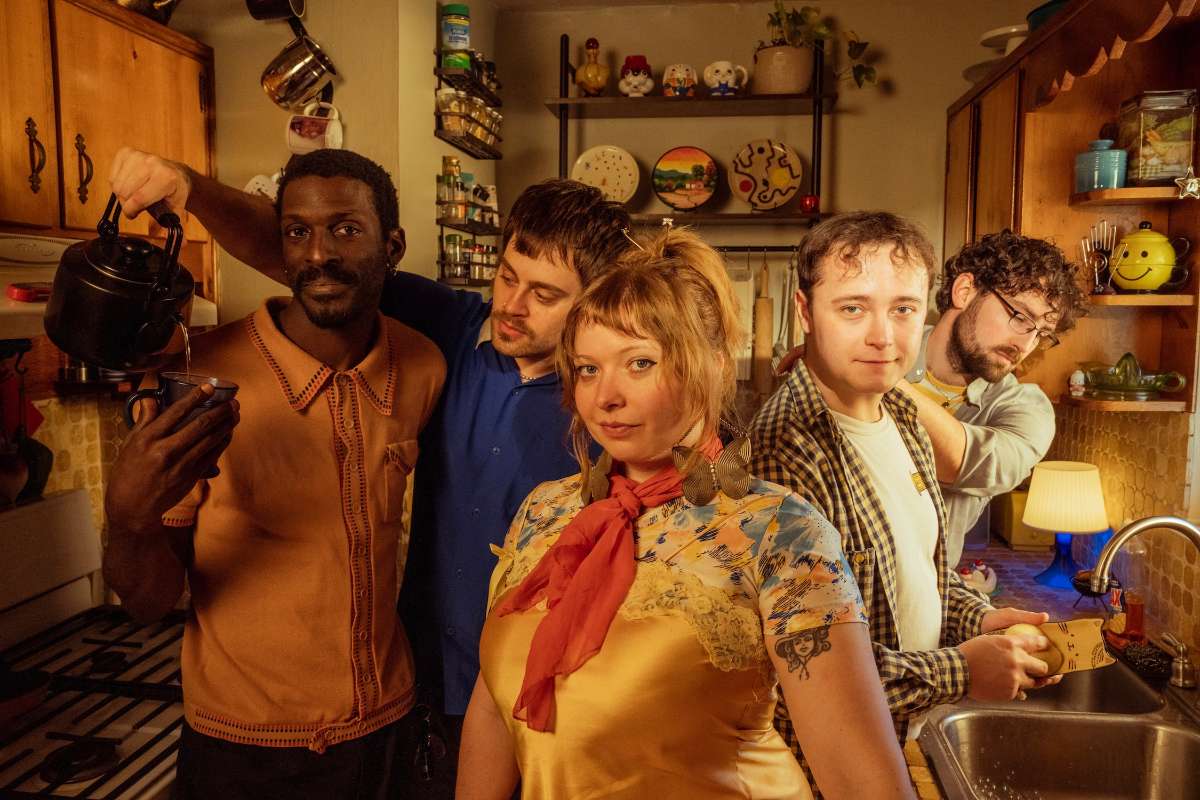
“You can do what you want to do (every day is yours)/ Baby, it’s your life/ (That’s right) It’s such a sick ride.” That’s Kevin Krauter and Nina Pitchkites, Wishy’s dual vocalists and songwriters, wrapping their voices around each other, symbiotic, coming to terms to with a conclusion: Life is, simply put, fucking crazy. In the whirlwind first few years of the band, there had been breakups, new love affairs, and yearning all while Wishy stormed the indie scene as an instantly beloved new act. That revelation by way of pep-talk arrives in the chorus of “Sensational.” Originating through Krauter’s experimentation with drum loops, the song is what should be an unholy fusion of sugary grunge and dream-pop. Yet Wishy’s latest jubilant remix of the past bears all their trademarks: zany lyrics transfiguring melancholia into freedom, an instant classic chorus that already feels like an old friend. It’s all quintessentially Wishy, and yet unlike any Wishy song you’ve yet heard—which made it the perfect song to give their vibrant sophomore album Nature’s Pill its name.
Wishy’s origins go way back, to when Krauter and Pitchkites met in high school in Indianapolis. Some years and a few projects later, they joined forces to form Wishy, rounding out the lineup with guitarist Dimitri Morris, bassist Mitch Collins, and drummer Conner Host. The group’s musical synergy was intense from the jump and the beginning of their career has been a prolific burst: the Mana and Paradise EPs in 2023, debut LP Triple Seven in 2024, and a follow-up EP Planet Popstar in 2025. After those releases met acclaim and the band’s stature rose, the conception of Nature’s Pill was fundamentally different.
“The songs were still flowing, but this album was more intentional,” Pitchkites says. “There was also some pressure of knowing we were working toward a definitive project,” Krauter adds, drawing a line from the early days when the band had a vault of material but hadn’t yet built an audience. “It gave these songs a more cohesive world to exist in, even if that world is a Pandora’s Box of everything.”
The entire project was a more collaborative effort. After writing separately for all of their debut, Krauter and Pitchkites sat down to write together as much as solo; Morris and Collins contributed to the writing process. The group reconvened with Triple Seven co-producer Ben Lumsdaine in Los Angeles, where the quintet packed into a tiny studio and tracked half the songs live in the room, imbuing the album with the immediate energy of a band in sync after heavy touring. It gave them the ability to synthesize an even greater array of touchstones this time around, with the ‘90s dream-pop and alt-rock of Triple Seven fusing with ‘80s college rock and ‘00s indie. “We were getting a bit more twee with it, embracing the young hipster headspace we had in high school,” Krauter says.
Just as their sound is often a swirl of various alternative and indie traditions, Wishy’s new songs collide the highs, pitfalls, and banal detritus of human experience alike. Nature’s Pill re-examines some of Wishy’s favored themes under new lights, jumping off from breakup songs to more abstract meditations on forlornness, romantic intention, lust. “We take that stuff and almost write in a fictional, hypothetical frame of mind,” Krauter explains. “The songs capture romantic frustration and neurotic desire and the melodrama that ensues from simply being a person with emotions experiencing relationships and inner turmoil. But it’s embellished—nothing we do is overly confessional.”
“It’s historical fiction,” Pitchkites quips.
Yet Wishy render even their heaviest, most poignant moments with humor and color. Far from being a downer lovelorn record, Nature’s Pill also lights up with open horizons glimpsed after romantic fallout: new people to meet, new places to live, new sounds to chase. And when there are moments of abject heartbreak or loneliness, they spike it with their customary cheekiness.
It’s already there in opener “All The Rage,” a jangly rush in which Krauter channels the teenage angst that can descend again even in adult breakups. From there, Nature’s Pill showcases Wishy’s mastery of pop hooks over and over, twisting structures and delivering unshakeable choruses in every song. In “Covergirl,” Pitchkites tackles another “all the rage” topic, writing about the emptiness of situationships over layers of overdriven guitar that buoy her to a chorus that conveys numb despondence and gorgeous daydream simultaneously. Whether the swooning glide of “Lovesick” conjures its namesake state of being or the hazy summer afternoon strums of “Mona Lisa” crest into a singalong outro, Wishy’s music seems to emerge from a fantasy realm: triggering memories of late ‘90s and early ‘00s crossover alt hits, but rendered with Wishy’s sharp songwriting acumen and free-for-all verve. Fittingly, it all culminates in the proudly “delulu” closer “Party World,” with Krauter singing what amounts to a manifesto for Nature’s Pill: “Life’s a game where nothing’s out of bounds/ And love’s a circus/ Everyone’s a clown/ It’s no big deal cause everybody knows that/ Heaven is a state of mind.”
Underneath it all, Wishy locate a tenacity to keep trying anyway. “Being in an indie band feels bizarre when the world is on fire,” Krauter concludes. “What can you do at the end of the day other than carve out some space—at the very least I have my imagination and I can invite others to join me there. At a certain point you need to say fuck it and roll with it.” Sometimes you can’t make sense of it all. Nature’s Pill finds Wishy gleefully giving into the madness. After all: If life is absurd, all the possibilities are up to you.
The best teachers never stop learning. They listen closely, stay curious, and let what they discover shape how they guide others. On their new self-titled album as youbet (due May 1st 2026, via Hardly Art), longtime music educators Nick Llobet (he/they) and Micah Prussack (she/her) proudly act as both explorer and guide, sharing three-dimensional musical sculptures so confidently and esoterically their own that they couldn’t have been released under any other name but youbet. Created in motion and shaped between long stretches of touring, the album reflects a moment of ecstatic possibility and grit. Both sharpened and expansive, youbet grows from the confines of home recording and “bedroom pop” into something sturdier, louder, and unmistakably their own.
“I myself am a constant student of life, of creating,” Llobet says. “I see people’s creative anxieties because I have lived them. It’s very therapeutic because I can tell that I’m giving people strong advice based on all my failures.” Llobet relocated to New York from Denver in 2013 and forged initial connections in the local scene, while creating youbet and writing two albums, but it wasn’t until meeting Prussack in 2022 that they discovered a different level of musical connection. When the duo started playing together, they quickly realized their uniquely shared musical language and eagerness to learn from everything, connecting over a vast array of musical influence and their own practice of teaching. “Early in our friendship, Nick and I were playing guitar in the park and we decided that the Beatles were so good because they learned how to play hundreds of songs together,” Prussack says. “So we began our quest to learn 1,000 songs. Nick started compiling a massive playlist called ‘Learn Me’ filled with music that we habitually study and generate new ideas from.”
The duo began experimenting musically, and their subsequent year of touring led to a new, more refined sound. “We had a huge opportunity for reinvention,” Prussack says. “Nick will never play the chord that you expect, and is always pushing me outside of my creative box. Their compositions are so exciting to explore, and on tour we began to reconsider and transform the kernel of each song to match our new environment.”
That depth of surprise and expansive warmth radiates from album opener “Ground Kiss”, a late-night existential query written when Llobet found themselves adjusting to living alone after the end of an 11-year relationship. “The song represents an endless search for that something and the rebuilding that goes along with trial and failure,” they say. The song unites the spectrum between clouds of plucked Big Thief-esque glow and bursts of distorted frustration. To that end, youbet demonstrates Llobet and Prussack’s ability to weave beguiling musical and lyrical expression, pushing and pulling at the resulting mesh.
Developing their finely tuned fusion between complex musicality and deeply felt emotion required more than hoping inspiration would strike. Instead, the process of creating youbet involved countless hours of precise engineering, meticulous craft, and gritty dedication. The duo were consistently listening, learning, and writing. But that hard work boils down into every facet of their work, including bringing a set of dumbbells on tour so they could keep active and stay disciplined. For their part, Llobet sees the resulting album as a statement of that hard work and the opening of a new chapter. “It’s the beginning of a new era for youbet,” they say. “The band
started as a sort of bedroom project for myself, but it has transformed into something expansive since working with Micah. It’s like we’re running a family business.”
The broiling “Undefined” draws from that personal soul-searching, a musical mosaic of life before and after a complicated breakup. Llobet first worked out the verses while waiting for a guitar student, a fitting backdrop for the song’s balance of wizardly art pop experimentalism and diligent power pop hookiness. Co-producers Katie Von Schleicher and Julian Fader help round out the mix, the former adding synth glisten and the latter a drum backbone hammered into place by Prussack’s bass.
The concussive “See Thru” rushes headlong through heavy alt rock chop, moments of gentler curve, and even bubbly electronics—a track Llobet notes began when they were toying with a Debussy piano part on guitar and then stamped in the harmonics and energy of Japanese hard rock band Boris. Elsewhere, “Receive” finds Llobet carving away at generational conflict, tethering propulsive bursts of guitar reverie with raw emotional vigor in the vein of Pile. “On the verse, the bass is playing variations on the vocal melody,” Prussack says. “Throughout the album, there’s unique interplay and variation that you can only get from a lot of hard work together.”
Echoing their strengths as educators, the ability to voraciously learn from a breadth of influences informs youbet—from the dizzying score to Alfred Hitchcock’s Vertigo to dazzling flamenco—but their ability to recognize meaning beyond signposts and find connections to emotional experience pushes everything into a topographical realism. “Having respect for the canon doesn’t mean we’re ever limited by revivalism. There’s a whole universe of musical vocabulary that we can borrow from and translate into our language,” Prussack says.
That willingness to learn from the past while building the future is something tied deeply to the band’s New York City roots, with so many visionary artists having previously built new worlds within the city’s confines. “For years, I was too intimidated to step into the scene. It’s been such a breath of fresh air to build this new craft, this new philosophy of songwriting in a scene I respect and feel in community with,” says Llobet.
Compelling art requires an unimaginable burst of new life, a shift from two-dimensional ideas to viscous, sinewy reality. As much as the hard work bolsters the music, it’s truly the resounding spirit of Llobet and Prussack’s relationship at the core of youbet. “Micah has brought a lot of order to my chaotic neurodivergence,” Llobet reflects. “I consider her my musical confidant. She can be cleverly critical and extremely encouraging. She’s probably the most opinionated person I know. Together we build this musical balance.” What emerges is an album that doesn’t just break free of its former constraints, but reconfigures them into something sturdier: a collaborative language capable of holding contradiction, growth, and connection all at once.